I’m going to say something that sounds dramatic, but I mean it in the nicest way: if you have a planted tank, your plants are not decorations — they are working staff.
Filters are brilliant tools. They provide flow, oxygenation, mechanical trapping, and surfaces for biofilm. But plants bring something filters don’t do on their own: they actively remove nutrients by turning them into biomass. In other words, they eat the stuff that would otherwise hang around and cause trouble.
Plants don’t only “use nitrate”
A very common beginner belief is: “Bacteria handle ammonia and nitrite; plants handle nitrate.” Reality is more interesting.
A major point raised by Diana Walstad is that many aquatic plants strongly prefer ammonium over nitrate, and they often take it up through their leaves from the water column when it’s available. That is a big deal because ammonium (and ammonia) is the form that becomes toxic fastest in fish tanks.
Peer‑reviewed plant research backs up the idea that submerged aquatic plants can take up ammonium through above‑ground tissues, and that above‑ground parts can play a major role in ammonium uptake and utilisation.
So in a heavily planted aquarium, plants can directly reduce nitrogen stress — not as a “nice extra”, but as a meaningful pathway.
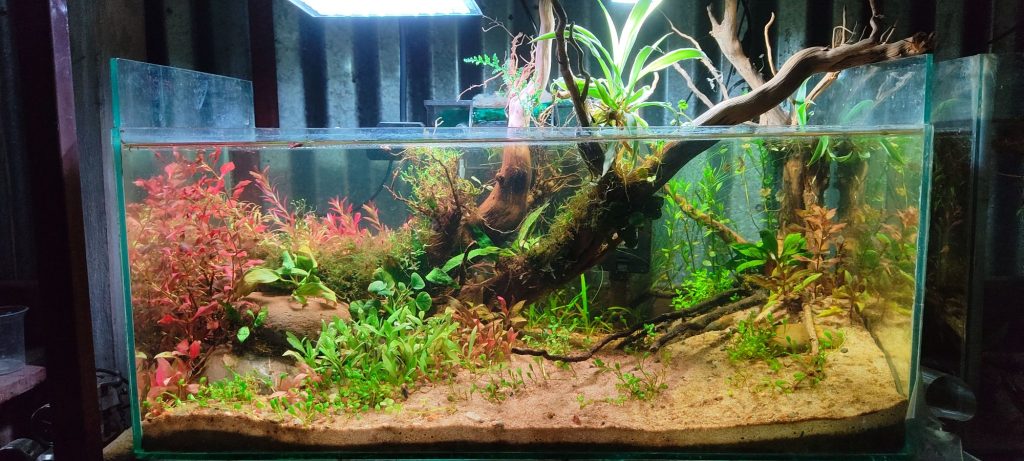
Plants also help because they slow the whole system down
In low-tech setups (lower light, no injected CO2), plant growth is slower. That can sound boring, but it’s secretly a superpower. Slow growth usually means slower nutrient demand swings, fewer “boom and bust” moments, and fewer algae outbreaks caused by sudden imbalance.
Plants create habitat for microbiology
Every leaf is surface area. Every stem is surface area. Plant roots, especially in soil-based tanks, create micro‑zones where oxygen levels and nutrients shift over tiny distances. Those micro‑zones support different microbial processes in the same tank, at the same time. That diversity tends to smooth out spikes.
So should you ditch your filter?
Not necessarily.
If you’re keeping a high bioload (lots of fish), if you like crystal-clear water, if you overfeed sometimes (we all do), or if you want extra circulation, a filter can still be a great friend. The “plants over filters” idea is mostly about where the core stability comes from in a planted aquarium: stable plant mass plus stable biofilm equals stability.
A filter is equipment. Plants are biology. And in ecosystem tanks, biology usually wins.
Before you go, check my shrimp game — just go home and wake up the shrimp.
Quick summary (save this)
– Many aquatic plants prefer ammonium over nitrate and can take it up through leaves.
– Plants can reduce nutrient stress and compete with algae by consuming available nutrients.
– Plant surfaces and root zones support diverse biofilms and micro‑habitats.
– Filters are helpful, but plants change the “waste pathway” by turning nutrients into biomass.